Designing with Indigo Peach Watercolor Floral Clipart: A Technical and Creative Guide
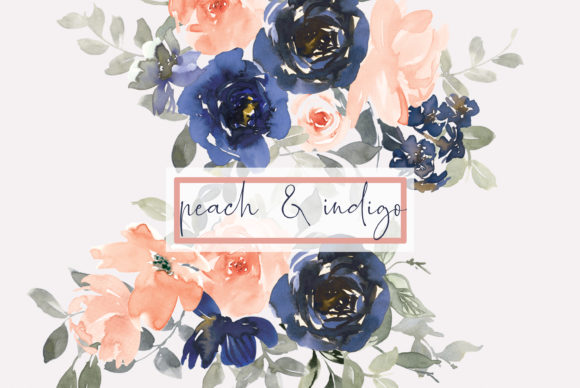
The intersection of deep, moody indigo and soft, warm peach creates a color palette that is both sophisticated and approachable. For designers, educators, and business owners seeking to elevate their visual assets, the Indigo Peach Watercolor Floral Clipart collection offers a specific solution to common design challenges. Unlike generic floral packs, this curated set balances large-scale compositional elements with intricate detailing, allowing for versatility across print and digital mediums. Understanding the technical specifications and practical applications of these assets is essential for maximizing their value in professional and personal projects.
Technical Specifications and File Integrity
Before integrating any digital asset into a workflow, understanding the underlying file structure is paramount. The Indigo and peach watercolor floral clipart collection is engineered for high-fidelity reproduction. All files are delivered as PNGs with transparent backgrounds at 300dpi resolution. This specification is the industry standard for professional printing, ensuring that edges remain crisp and colors do not pixelate when scaled.
The transparency of the background is a critical feature for layered design work. It eliminates the need for tedious masking or background removal, preserving the delicate, organic edges characteristic of authentic watercolor media. When working with indigo tones, which can sometimes appear muddy if compressed, maintaining 300dpi ensures the depth and saturation remain consistent from screen to substrate. Whether designing a small business card or a large-format poster, the resolution supports significant scaling without degradation.
Asset Breakdown and Dimensional Utility
Versatility in design often comes down to having the right size element for the specific spatial constraint. This collection is categorized into four distinct functional groups, each serving a unique purpose in layout architecture:
- 14 Arrangements (Approx. 12” x 7”): These mid-sized compositions serve as primary focal points. Their horizontal orientation makes them ideal for headers, landscape invitations, or central branding elements.
- 48 Smaller Elements (Approx. 3”x2” to 4”x2”): These individual blooms and foliage pieces are the workhorses of custom composition. They allow designers to build bespoke borders, fill negative space, or create scattered patterns without relying on pre-set arrangements.
- 2 Wreaths (Approx. 15”x18” and 17”x14”): Large-scale circular frames designed for enclosure. The varying dimensions accommodate different aspect ratios, perfect for certificate borders, menu enclosures, or social media profile framing.
- 3 Frames (Approx. 17”x16” and smaller): Structured boundaries that provide immediate hierarchy. These are essential for text-heavy designs where readability must be balanced with decorative aesthetics.
Color Psychology and Palette Integration
The specific combination of indigo and peach is not merely aesthetic; it carries psychological weight that influences viewer perception. Indigo communicates trust, stability, and luxury, while peach evokes warmth, creativity, and approachability. When utilizing Indigo Peach Watercolor Floral Clipart, designers are leveraging this duality to create balanced emotional responses.
In corporate stationery, the indigo anchors the design in professionalism, preventing the florals from appearing overly whimsical. Conversely, in wedding or event stationery, the peach softens the formality of the indigo, making the overall aesthetic feel romantic rather than austere. This chromatic balance allows the clipart to transcend niche categorization, making it suitable for diverse industries ranging from legal services to boutique retail.
Typography Pairing Strategies
Because watercolor textures possess inherent visual noise, selecting appropriate typography is crucial. With the indigo and peach palette, contrast is key. White or cream serif fonts perform exceptionally well against the darker indigo leaves, enhancing legibility and elegance. For areas dominated by peach florals, charcoal or deep navy sans-serif typefaces provide necessary grounding without competing with the artwork.
The organic nature of the brushstrokes in this collection pairs best with typefaces that have humanist qualities. Rigid geometric fonts can sometimes clash with the fluid movement of watercolor, whereas transitional serifs or modern calligraphy scripts complement the hand-painted aesthetic. When using the 17”x16” frames, ensure adequate padding between the text block and the floral edge to maintain breathing room and visual clarity.
Practical Applications Across Industries
The utility of the Indigo and peach watercolor floral clipart collection extends far beyond simple decoration. Different sectors utilize these assets to solve specific communication problems.
Event Planning and Stationery Design
For wedding planners and stationers, the two wreaths (15”x18” and 17”x14”) offer immediate solutions for welcome signs and seating charts. The larger dimension accommodates standard easel sizes, reducing the need for digital manipulation. The 48 smaller elements are particularly valuable for creating cohesive table numbers and place cards that match the main invitation suite without looking repetitive. By scattering individual peach buds and indigo leaves, designers can create a rhythm that guides the eye across multiple printed pieces.
Educational and Academic Resources
Educators and researchers creating presentations, worksheets, or certificates benefit from the structured nature of the frames. In academic contexts, visuals must support content without distracting from it. The indigo tones provide a mature, scholarly backdrop suitable for diplomas or award certificates, while the transparent PNG format allows these elements to be placed over colored paper stocks or digital slides seamlessly. The 12”x7” arrangements fit perfectly within standard PowerPoint or Keynote slide dimensions, serving as title slide backgrounds that leave ample negative space for text.
Small Business Branding and Packaging
For entrepreneurs, consistent branding is vital. This clipart collection provides a library of assets that can unify packaging, social media, and web presence. The smaller 3”x2” elements are ideally sized for product stickers, thank-you cards, or watermark overlays. Because the files are high-resolution, they can be printed on textured cardstock or glossy labels without losing detail. The interplay of indigo and peach works particularly well for beauty brands, artisanal food products, and wellness services, where natural aesthetics signal quality and care.
Workflow Optimization and Layering Techniques
To extract maximum value from the Indigo Peach Watercolor Floral Clipart, users should adopt specific digital workflows. Since all files are separate PNGs with transparent backgrounds, layering is the primary method of customization.
Creating Custom Compositions: Do not rely solely on the pre-made arrangements. Use the 48 individual elements to extend the edges of the 12”x7” arrangements if a wider aspect ratio is needed. Overlapping individual leaves onto the base arrangement creates depth and breaks up uniformity, resulting in a more organic, handcrafted appearance.
Opacity and Blending Modes: While the files are vibrant, adjusting opacity can create subtle background textures. Setting an indigo leaf to 20% opacity creates a watermark effect suitable for letterheads. In software like Photoshop or Procreate, experimenting with "Multiply" or "Overlay" blend modes can integrate the florals into colored backgrounds more naturally, simulating the way real watercolor pigment interacts with paper.
Print Preparation: Always verify color profiles before printing. Although the source files are RGB (standard for digital display), professional printers often require CMYK conversion. Indigo can shift toward purple during this conversion. It is advisable to request a physical proof or use a calibrated monitor to ensure the deep blues retain their intended tone. The 300dpi resolution provides a safety buffer, but keeping the final output size close to the native dimensions (e.g., printing the 17”x14” wreath at or below 17”x14”) guarantees optimal sharpness.
Considerations for Digital vs. Print Usage
While high resolution benefits print, digital applications require different considerations. For web use, the full-size 17”x16” frames may result in unnecessarily large file sizes that slow page load times. It is best practice to resize and compress PNGs for digital platforms while retaining the transparent background. However, for digital downloads or printable wall art products sold by creators, retaining the full native resolution and DPI is non-negotiable to meet customer expectations for quality.
The transparency of these files also facilitates accessibility. When placing text over the Indigo and peach watercolor floral clipart collection, always ensure sufficient contrast ratios. The intricate details of watercolor can reduce text legibility. Using solid color blocks behind text or positioning copy strictly within the negative space of the wreaths and frames ensures that the design remains inclusive and readable for all audiences.
Maximizing Asset Longevity
Trends in color and style evolve, but the fundamental construction of this collection supports longevity. The separation of elements means the assets are modular. If indigo falls out of favor in future seasons, the peach elements can stand alone or be recolored digitally. The classic botanical forms avoid hyper-stylized trends that date quickly. By treating this collection as a foundational design system rather than a single-use graphic pack, professionals and hobbyists alike can derive sustained value.
Ultimately, the effectiveness of Indigo Peach Watercolor Floral Clipart lies in its technical precision and compositional flexibility. From the expansive 17”x18” wreaths to the minute 3”x2” accents, every component serves a functional role in visual communication. By respecting the resolution requirements, understanding the color dynamics, and employing strategic layering techniques, users can transform these digital assets into tangible, impactful designs that resonate across varied contexts and audiences.